A U-Turn Dispute: Can it be Resolved with Limited Data?
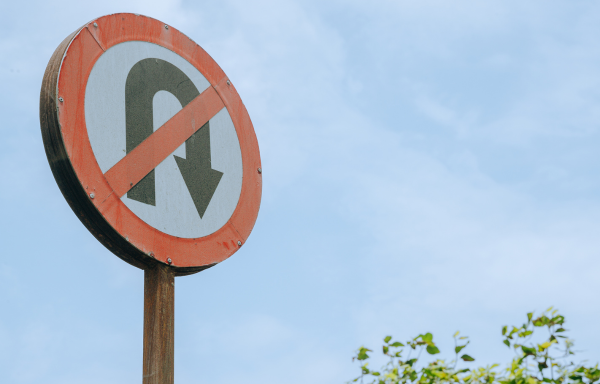
Case Summary: Heading northbound on a sunny day, a stone mason operating a work truck went to execute a U-turn at a signal-controlled intersection. There were no sight distance limitations and no signs indicating that U-turns were prohibited. He testified that while turning from the left northbound travel lane, he was “rear-ended” by a Toyota passenger vehicle, which was also in the left lane, behind him. Simple rear-end collision… right?
While the Toyota operator agreed that she was in the left lane and that the truck was making a U-turn, her claim was that the truck began its turn from the adjacent lane (immediately to her right) and then turned across the left lane, cutting her off. In addition to no measurements being recorded at the scene and the absence of any witnesses, by the time the case reached litigation, neither vehicle was available for inspection. However, several photographs were taken which showed damage to the vehicles and the point of rest position of the truck.
Expert Analysis: Through the use of the vehicle specifications along with the damage photographs, to-scale 3D computer models of each vehicle were created which accurately reflected the damage profiles shown in the photographs. Based on these profiles, the Principal Direction of Force (PDOF) necessary to create the damage was defined. Next, the PDOFs acting on each vehicle (and independent of any testimony) were aligned, thus defining the angle of impact based solely on the physical evidence and the laws of physics. The data established that the impact was between the front of the Toyota and the left rear corner of the truck – indicating that this was not a “classic” rear-end collision. Finally, the testimony was considered under the backdrop of the physical evidence and the laws of physics. The angle of impact established by the damage did not align with the stone mason’s description of where he was, and his description of how he was hit was not consistent with the physical evidence. The testimony of the Toyota operator (that the truck moved across her path from the right) was consistent with the angle of impact, the point of rest of the truck, and the motion of the vehicle defined by the mechanical and geometric limitations of the vehicle. Even though the vehicles were not available, and no measurements were recorded at the scene, the dispute was scientifically resolved by using photographs of the damaged vehicles and applying basic physics.
Result: The case went to trial and the jury found in favor of the Toyota operator.
Justin P. Schorr, Ph.D.
Principal Collision Reconstruction Engineer
View all articles by Justin P. Schorr, Ph.D.