Interview with Laura M. Miele, Ph.D.
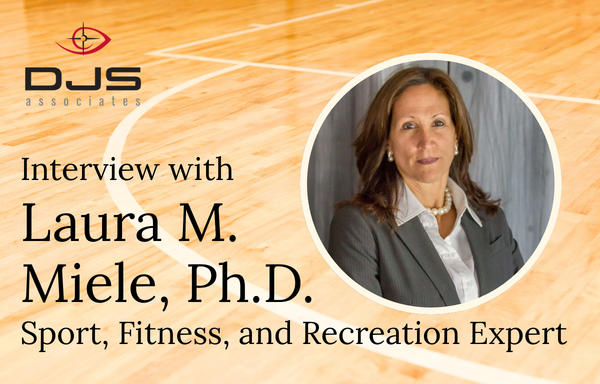
Dr. Laura M. Miele, Sport, Fitness, and Recreation Expert with DJS Associates, Inc., draws from a unique background that blends psychology, athletics, and legal consulting. In this interview, she shared experience-based insights on facility standards, risk management, and litigation support.
DJS Associates, Inc.: Can you walk us through what a sports, fitness, recreation, and education expert does?
Laura Miele: I am retained as an expert when somebody is injured or killed in a sporting event or at a fitness facility, recreational facility, or even an educational institution. First, I investigate what happened by inspecting a piece of equipment or the area in which somebody was injured. Then, I provide a written report regarding the standard of care or the best industry practices. Finally, if necessary, I testify at mediations and trials. I render opinions for the plaintiff and the defense.
DJS Associates, Inc.: How would you describe your analysis for your investigations?
Laura Miele: I use methodology based on the American Society for Testing and Materials, or ASTM International. My forensic analysis involves reviewing all the facts of a case, along with my experience, training, and education, and using scientific methodology that I have learned and studied to form my opinions. Then, I reference the standards or the references within the industry to support my opinions.
DJS Associates, Inc.: In what ways do you support legal teams in understanding the context and standards involved in injury-related litigation?
Laura Miele: I’ve been in the sports, fitness, recreation, and education industry for over 30 years. My insights provide legal teams with information they otherwise wouldn’t have known. I can provide them with information or show them how to find specific areas within the industry that will help with their case.
DJS Associates, Inc.: How have your past roles shaped your commitment to safety in your work today?
Laura Miele: That’s a great question. I worked in a jail, so anytime we were training, the focus was on safety and security. “Make sure you and your partner are safe.” “Make sure the environment is safe.” “Make sure the juveniles that you’re working with are safe.” Safety and security were embedded in me.
Then, as I was teaching, especially in physical education, safety was a huge component. You had to walk out in the field and make sure there weren’t any major holes or ruts in the grass or the turf. You’re taught so much about how to be safe, and it just translated into everything I did, which made it a lot easier for me to be the expert that I am. You want to make sure, when you’re working with children and training and coaching, that you know everything’s as safe as it can be.
DJS Associates, Inc.: How does your background in sports psychology enhance your forensic work?
Laura Miele: Sometimes I can incorporate my sports psychology background when an injury involves psychological readiness. You would see this in gymnastics or cheerleading when an athlete has not properly progressed through a series of exercises. In these cases, I can discuss the psychological ramifications of what happened during the incident.
For instance, imagine a coach suddenly says to the cheerleader, “Hey, why don’t you become a flyer?” She has never been a flyer before, and now they’re saying, “Okay, we’re gonna throw you up in the air!” The girl is petrified, and that’s where the psychological component comes in. Typically, they will end up falling, or something bad will happen because they were not properly trained or psychologically ready for that exercise.
DJS Associates, Inc.: Why is consulting an expert in sports and recreation risk management important for schools, gyms, and other establishments with athletic facilities?
Laura Miele: We have the trained eye. When you have the experience and education behind you, you’ll walk into a facility and see things other people will not. I’ll walk into a gym where there are multiple different sports being offered and see benches too close to the court side or walls and areas that are not padded. I’ll recognize when it’s foreseeable that a participant could come into contact with or run into those surfaces. Experts have a different set of eyes and can pick up probability hazards more effectively than a layperson.
DJS Associates, Inc.: Are there certain types of activities or environments where you tend to see more safety issues, particularly when new trends emerge?
Laura Miele: Issues arise everywhere, so I can’t say for certain there’s just one. There have been times when I am contacted on climbing incidents for a few months in a row. Then, I’ll have an influx of roller-skating cases. I can’t say that there’s one specific area; however, anything that’s new, like a ninja course, can come with challenges. In ninja, parkour, or other new attractions or courses they’re trying to place in these facilities, you’ll see a rise in cases until new standards come out or the Consumer Product Safety Commission (CPSC) steps in.
DJS Associates, Inc.: What are the biggest risks you see in sports and recreation environments today?
Laura Miele: The biggest risks being seen right now are the new areas coming out that have not been properly vetted. The trampoline park industry has always featured different attractions and continues to introduce new ones. ASTM promulgates international standards through the industry that address safety and best practices. Owners and operators don’t always run a risk or deny device analysis. Some of the biggest risks and hazards you’ll see are in new areas where the standards don’t keep up with industry safe practices. Although standards place everything on the manufacturers, the owners and operators are the ones who are directly involved with day-to-day situations and are able to determine if there needs to be a change for an attraction to be safer. It could be adding more padding to an area or placing more staff to supervise.
DJS Associates, Inc.: What are some common misconceptions the public has about safety and risk in sports and recreation environments?
Laura Miele: One misconception is that everything is inherent, but that is not the case. An inherent risk could be that you and I are playing basketball, we both go up for a rebound, then I land on your foot and blow out my ankle. That’s an inherent risk in a sport. A misconception is that every time people go into a facility, it will be safe, because people expect a safe environment, but that’s not always the case.
DJS Associates, Inc.: What is the importance of having emergency action plans for these facilities?
Laura Miele: Emergency response or emergency action plans encompass all different things: how you’re going to handle an injury, who’s going to handle it, who’s making the call to 911, who is grabbing the AED and the first aid bag, and how well are they trained?
The importance of these emergency action plans goes beyond just having them on paper. They must be properly executed. They need to be rehearsed. According to the American College of Sports Medicine, they should be rehearsed quarterly or at least every 6 months, even to the point where you are practicing a specific type of emergency, like a cardiac event. Emergency action plans are vitally important to the well-being of the person who was injured or possibly in a very serious state, such as a cardiac episode.
DJS Associates, Inc.: How do you typically determine whether safety protocols were in place at the time of the incident?
Laura Miele: In my analysis, I read through testimony, policies, and procedures, and check to see if there was an employee manual. Do they match the industry standard? Then, I’m looking to see if the staff were properly trained and actually followed those policies, procedures, and manuals.
DJS Associates, Inc.: What role does education play in preventing recreational injuries?
Laura Miele: You can’t prevent all injuries. I will never say that everything is preventable. The owner or operator of a facility needs to educate themselves. When they purchase equipment, it comes with a manufacturer’s manual. This manual will often include the do’s and don’ts of usage, as well as instructions on how and when to properly maintain and inspect it. Then, it’s important to take it a step further and perform a risk analysis to help prevent injuries. However, we prefer to use the word “mitigate” rather than “prevent.” Our goal is to decrease the incidence of injury because not everything is preventable.
DJS Associates, Inc.: What are the most surprising changes to industry standards since the start of your work? Are there any that particularly stuck out to you?
Laura Miele: It’s the lack of standards that’s most surprising to me. Some of them are loosely based and protect the manufacturer, when the duty to provide safety should fall more on the manufacturer to do as much as they possibly can to create as many safe uses as possible. To take it a step further, the owner or operator must also be culpable for how their facility is operated.
DJS Associates, Inc.: What message do you hope coaches and professionals take from your work on injury mitigation?
Laura Miele: It’s not one-size-fits-all when you train and work with athletes. You need to know your athletes and their medical history to keep everyone safe.
DJS Associates, Inc.: Are there any obstacles you face working in this industry?
Laura Miele: Standard of care is not always black and white. There are many gray areas between carefully developed standards and loosely written guidelines. The world of science and engineering tends to be more centrally organized. Standard of care experts must determine how safety extends across different venues and how to integrate it all to demonstrate its relevance to other industry best practices related to incidents where standards have not yet been established.
DJS Associates, Inc.: Outside of consulting, how do you stay connected to the sport, fitness, and recreation world?
Laura Miele: My whole life is the sport, fitness, recreation and the education world. All I do is watch games, watch coaches, and watch behaviors. I was just watching one of my clients play softball in a championship recently. I am always watching sports. I teach group boxing at the YMCA to stay very connected to what I do. When I do this work, I’m knee-deep in being involved. I’m not far removed from the things I typically work on in my cases and from what I do in the industry.
DJS Associates, Inc.: Is there a moment or achievement in your career that you’re especially proud of?
Laura Miele: My goal is to be a well-known safety consultant for sport, fitness, recreation, and education before I retire. I think my biggest achievement is just being proud of what I do. It’s doing it across different venues as an expert consultant, as a coach, as a trainer, and as a sports psychology consultant.
DJS Associates, Inc.: It’s incredible that you get to do something you love every day.
Laura Miele: I absolutely love this work. I enjoy being proactive and speaking on podcasts about safety. I used to go out and talk to physical education teachers, teaching them how to be safe and how to progress through training or exercises. I work with many teams in Pennsylvania, both college and high school. Coaches often seek my opinion, like, “Hey, can you watch the game?” or they might say, “I don’t think I’m connecting with my players.” Sometimes, they’ll even ask, “I’m having a difficult time with this, do you see something that I’m doing wrong?” This allows me to study behaviors as well. I can engage all the areas I’ve studied throughout my life and bring them into practice with different people. I enjoy helping others, and I love that.
Laura M. Miele, Ph.D.
Sport, Fitness, and Recreation Expert
View all articles by Laura M. Miele, Ph.D.