Sudden Stop, No Recorded Cause: Investigating a Hospital Elevator Entrapment
Case Summary: In the early morning hours, a hospital employee arriving for an overnight shift boarded a passenger elevator in a parking deck to descend a single level. The car began to move normally and then, in the passenger’s account, “drastically dropped” before coming to an abrupt stop between floors. As she reached for support, a side handrail pulled free of the cab wall, and she remained entrapped on the floor of the stopped car for approximately fifty-five minutes. Plaintiff’s counsel retained an expert to determine the most probable engineering mechanism of the event and to evaluate whether the equipment had been maintained to the standard of care applicable to a certified elevator contractor.
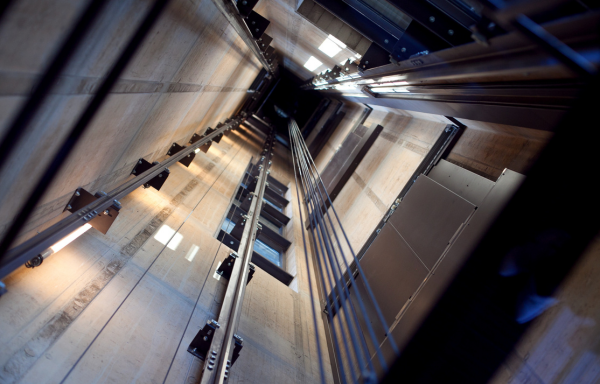
Expert Analysis: The subject elevator was a machine-room-less (MRL) design that uses slide guides, rather than roller guides, to hold the car in alignment with its guide rails. Equipment of this type is sensitive to friction in the guide-rail system: the rails are intended to be lubricated continuously, as the manufacturer designed, and when they are not, the resulting friction is sensed by the drive as an anomalous load. The control system, reading motor torque and motion data that no longer match expected values, can respond by commanding an abrupt, or ‘panic’ stop through the machine brake. To a passenger standing in the car, that braked stop is not easily distinguished from a fall.
On site inspection, the slide-guide lubricators mounted on top of the car were found either broken, with wick elements worn well past contact with the rail, or so far out of adjustment that they were not contacting the rail at all. By either condition, the guide rails were not being lubricated as the equipment was designed to be in normal service. That observation was consistent with the maintenance contractor’s contemporaneous service record for the date of the event, which identified the involved component as the car controller and described the corrective action in a single word: “Lubricated.” The entry was not a diagnosis; it was, at most, a description of what was done after the fact, and it pointed directly to the friction condition later confirmed on site.
The investigation was further constrained by what the records did not contain. No Maintenance Control Program documentation was kept on site for the unit, as the governing code requires, and no manufacturer test procedures, drive-parameter references, or controller fault-code documentation were available in any form. As a result, the precise fault code, brake-application sequence, and deceleration profile of the event could not be reconstructed. The handrail that released from the cab wall represented a separate deficiency. A handrail installed in a passenger car must be securely fastened and maintained, and this one separated under nothing more than the weight of a hand reaching for support. To a reasonable degree of professional certainty, the most probable mechanism of the entrapment was inadequate guide-rail lubrication. Excess friction at the slide-guide and rail interface generated a drive and controller fault, and the controller responded with an abrupt braked stop. The equipment configuration, the condition observed at inspection, and the contractor’s own contemporaneous record were mutually consistent on that point, and the absence of a documented Maintenance Control Program left the contractor unable to demonstrate that the equipment had been returned to service in a safe and code-compliant condition.
Result: Following expert disclosure, the matter was resolved by confidential settlement prior to trial.