Forensic Video Analysis: Using Videogrammetry to Find a New Angle
DJS Associates, Inc. (DJS) is often tasked with analyzing incident surveillance video evidence vital to a legal case or insurance claim, especially when issues of quality camera angle, objects obscuring the subject, changes to the location, or all of the above pose more complex challenges. Below are two examples of such cases that demonstrate how 3D laser scan data and reconstruction techniques revealed details imperceivable in the footage alone.
Case #1: Indoor Volleyball Injury
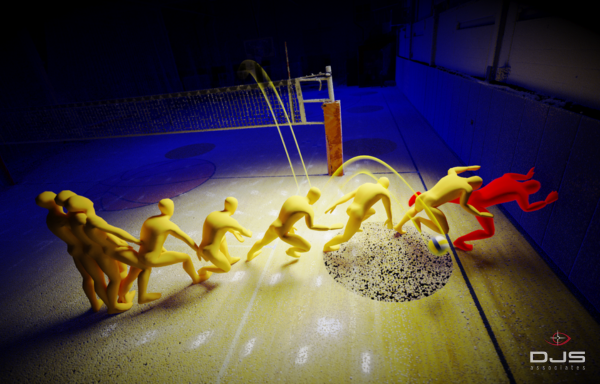
During an indoor recreational volleyball game, a player lost their balance and ran head-first into a padded wall, resulting in a debilitating spinal injury. DJS was retained to analyze video surveillance evidence, which captured the accident. The subject video provided was a recording, taken on a smartphone, of a monitor displaying the surveillance video of the accident.
Working with video that isn’t from the native surveillance system is a complex task in the best of circumstances, requiring extra levels of scrutiny to make subsequent steps in the analysis process as accurate and resolute as possible.1 A reverse-engineering process was required to stabilize handshake, remove distortion, and reconstruct the dimensions of the original video frame. Once returned to an acceptable composition within the established norms of digital video standards, the camera view could be calculated in three dimensions relative to high-density 3D laser scan data of the facility.
Plaintiff, the subject volleyball player, was then tracked in the 3D environment using a mannequin scaled to their height to accurately reconstruct the steps and posture recorded in the video. The resulting reconstruction allowed the scene to be viewed by multiple angles, helping biomechanical experts and other viewers better understand the circumstances of the event. Movements previously obstructed by objects in the foreground were also reconstructed through this process.
Case #2: Retrospective Trip & Fall Reconstruction
Video surveillance recorded an individual’s fall in a building lobby. By the time DJS was retained to analyze the video, the building had been renovated. A camera-match analysis was performed using 3D laser scan data collected by DJS’ reality capture crew. The camera’s position, orientation, and field of view were established by implementing common features present in the environment prior to and after the renovation. Several scene photos were also successfully camera-matched with the 3D laser scan data, further corroborating accuracy.
Of particular interest, an edge of a rug in close proximity to Plaintiff’s fall was obscured in the surveillance camera. The obstructed area of rug was established and reconstructed in a 3D environment by utilizing camera-matched scene photos from multiple angles. An articulated 3D mannequin was scaled to Plaintiff’s height, superimposed, and animated over the surveillance footage to match his position and posture in space and time. Under the guidance of DJS’ biomechanical expert, animation of the 3D mannequin was refined relative to the video evidence.
With an unobstructed view of the reconstructed scene, the analysis revealed Plaintiff’s footing in relation to the position of the rug’s edge with more detail and clarity than what could be determined from the surveillance video evidence.
In both cases, the combined efforts of DJS’ investigation team, animation and video specialists, and biomechanical experts allowed moments obscured in video surveillance evidence to be accurately reconstructed. While a fixed surveillance camera only sees events from a single perspective, it can capture crucial spatial and temporal data that, with the right forensic analysis techniques, can reveal more than it actually shows.
1 For more information, see the author’s previous post, Forensic Video Analysis: Distortions in Secondary Recordings.
Laurence R. Penn, CFVT
Senior Forensic Animation / Video Specialist
View all articles by Laurence R. Penn, CFVT