Commercial Vehicle Sideswipe – Who Was Going Faster?
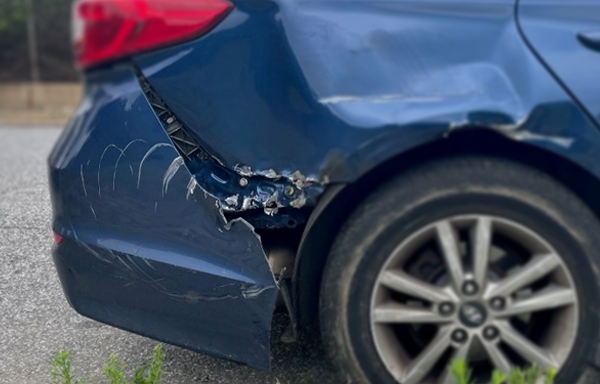
A sedan and a tractor-trailer were involved in a sideswipe collision on a three-lane highway. Each driver claimed that the other vehicle came speeding up from behind them, entered their lane, and caused the collision.
The collision reconstruction engineers at DJS Associates, Inc. examined the damage to the sedan’s rear bumper and quarter panel. Among the deformation and scraping was a spiraling damage pattern consistent with contact from the lug nuts on the tractor’s drive-wheel. This distinctive pattern, known as a lug-nut trace, holds valuable information about the vehicles’ relative motion during a sideswipe collision.
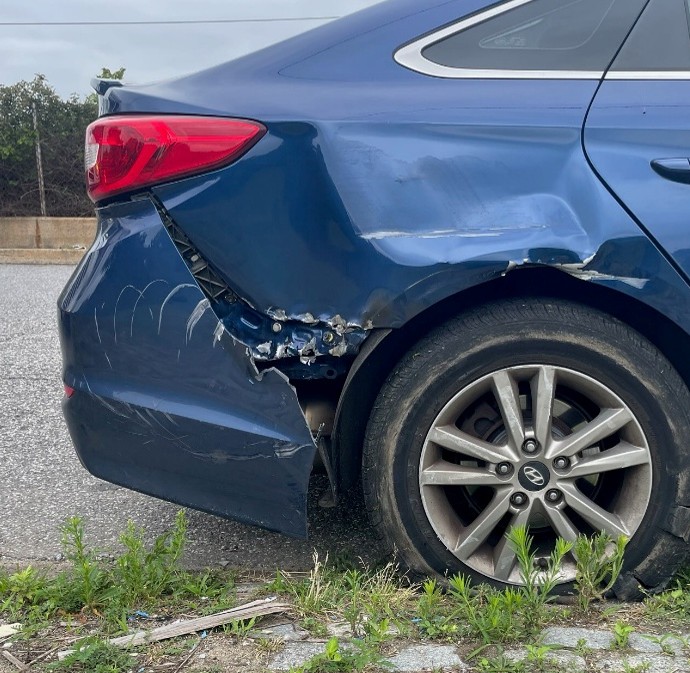
In sideswipe-type collisions involving the protruding lug nuts on a commercial vehicle, two motions occur simultaneously:
- The lug nut rotates in a circular path around the truck wheel’s hub.
- The truck wheel moves longitudinally relative to the passenger vehicle.
This combination transforms the lug nut’s circular motion into a repeating looped or spiral-shaped trace across the body of the adjacent passenger vehicle. These patterns can be modeled mathematically and, when sufficient measurements are available, can be used to evaluate the vehicles’ velocity ratio.
In same-direction sideswipe collisions, the orientation of the lug nut trace loops alone provides key information:
- Upward-oriented loops indicate that the passenger vehicle was traveling faster than the commercial vehicle.
- Downward-oriented loops indicate that the commercial vehicle was traveling faster than the passenger vehicle.
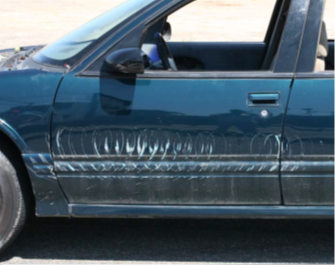
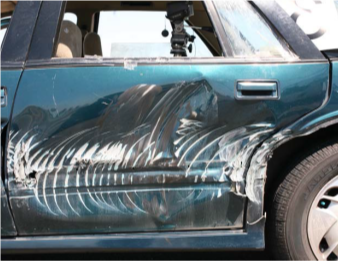
On the subject sedan, the trace exhibited upward-oriented loops, with crossover marks positioned below. The damage pattern established that the sedan was traveling faster than the tractor-trailer during contact. While this conclusion does not, by itself, identify which driver crossed the lane line or establish that either vehicle exceeded the posted speed limit, it does resolve a critical part of the conflicting accounts: The sedan was overtaking the tractor-trailer when the crash occurred.
Bailey A. Hentz, BSAE, ACTAR
Collision Reconstruction Engineer
View all articles by Bailey A. Hentz, BSAE, ACTAR