Evaluating Passenger Motion During Transit Bus Hard-Braking
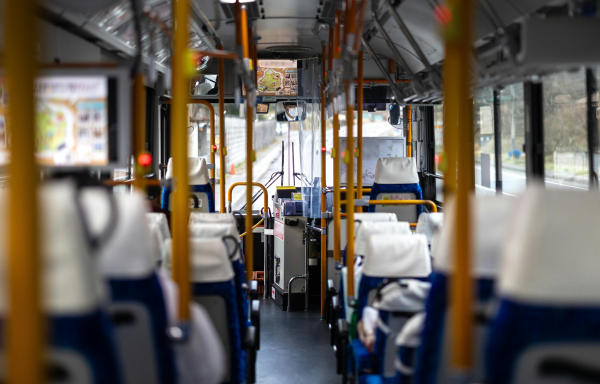
A transit bus passenger was seated on an aisle-facing bench seat when the bus began hard-braking. As the bus slowed, the passenger slid sideways across the plastic bench seat.
The passenger ultimately traveled the full width of the seat and struck the vertical partition adjacent to the entry steps on this bus. To quantify the dynamics of this event, the physical dimensions of the seat were measured to establish the total slide distance of the passenger. Interior surveillance footage was then analyzed to determine the elapsed time between the onset of motion and the moment of impact.
Using fundamental kinematic relationships, the passenger’s velocity relative to the bus interior at the moment of impact was calculated. Because the passenger struck a rigid partition, this impact velocity also represents the delta-V (change in velocity) experienced by the passenger, which is a key metric in assessing collision severity.
This analysis demonstrates how measurable occupant motion can occur even in non-collision scenarios. By evaluating geometry against time-based video evidence and applying basic physics, the relative dynamics of the passenger were objectively quantified. Such approaches provide clear, defensible insight into impact severity and are essential in the evaluation of injury potential.
Bailey A. Hentz, BSAE, ACTAR
Collision Reconstruction Engineer
View all articles by Bailey A. Hentz, BSAE, ACTAR