Reframing Trampoline Court Liability Through Engineering Systems & Standards
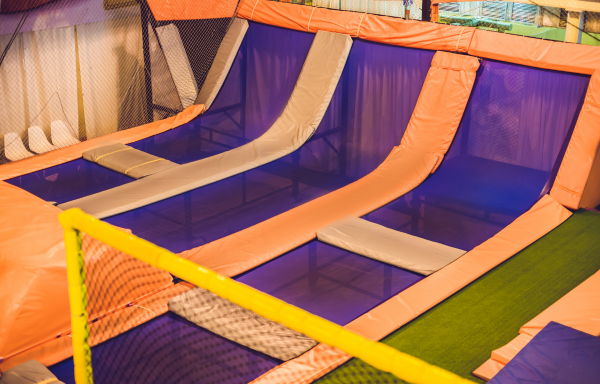
In more than 100 expert-witness engagements, injuries at trampoline courts are routinely misidentified as simple “bad landing” events. Operators’ incident reports often attribute causation and liability to patron behavior, and many injured individuals assume that a signed waiver resolves the matter. That narrative is convenient, but frequently incomplete. In high-energy amusement environments, serious injuries typically do not occur without contributing factors. For attorneys evaluating liability, the more consequential inquiry is not how the patron landed, but whether the operator, manufacturer, installer, and inspectors met the “standard of care” required in designing, building, managing, and maintaining the high-energy amusement environment.
Industry standards, most notably ASTM F2970 (Standard Practice for Design, Manufacture, Installation, Operation, Maintenance, Inspection, and Major Modification of Trampoline Courts), provide a useful framework for analysis. Developed within ASTM F24 (Amusement Rides and Devices), these standards are widely recognized across jurisdictions (with limited exceptions, such as Wyoming) and establish minimum requirements for the lifecycle of amusement systems. They treat trampoline courts not as casual recreation, but as engineered environments requiring systematic safety controls.
That distinction matters. A trampoline court is not a single device; it is a matrix of interconnected trampolines whose performance depends on the integrated behavior of frames, springs, attachment systems, and bed geometry. When properly designed and maintained, the system distributes and absorbs energy in predictable ways. When controls are absent, inconsistent, or undocumented, that predictability erodes, and with it, the operator’s ability to manage risk.
In practice, the recurring issues in litigation are rarely confined to patron conduct. Instead, they are often concerned with whether the operator adhered to manufacturer requirements, conducted and documented inspections, controlled access to high-performance areas, and prevented unauthorized modifications that could materially affect rebound characteristics and landing forces.
A Texas matter illustrates the operational dimension of the problem:
Available materials indicated that a patron was permitted to use a high-performance trampoline without executing a waiver, without receiving instruction regarding the equipment’s heightened rebound characteristics, and without having adequate supervision. Manufacturer guidance specified that such trampolines were to be used only under supervision and subject to regular inspection and documented maintenance. Yet, the corporate representative testified that daily inspections were allegedly performed without written documentation and repairs were made “as needed,” without records to identify what was repaired, when, or by whom. For counsel, such testimony is significant not because a form is missing, but because it suggests the absence of a controlled system for inspection, maintenance, and safe operation.
A New Hampshire matter highlights a different, but equally consequential issue of structural modification of a professionally engineered system:
During site inspection, steel members that had been cut, lengthened, and welded were observed beneath high-performance trampoline beds, altering what appeared to have been an original bolt-together frame configuration. From an engineering standpoint, this is not a mere cosmetic change. Trampoline performance depends on structural stiffness, geometry, and the interaction of components. Altering the frame can change energy return, affect bed deflection, and increase landing forces in ways that are not readily apparent to a user. The analysis concluded that these were major modifications requiring engineering evaluation and documented approval consistent with ASTM F2970. Poor design can turn a trampoline into something closer to a rigid platform, producing the “hard-surface” landings so often described by injured patrons.
These matters point to a broader lesson: trampoline court cases are systems cases. They turn less on isolated moments than on whether the operator implemented and maintained a coherent safety management system. Four areas, in particular, warrant close attention in discovery.
- Inspection and Maintenance Records: Claims of “daily inspections” carry little weight without documentation identifying who performed them, what was inspected, and what corrective actions were taken. A lack of records may indicate not just poor paperwork, but the absence of a functioning inspection program.
- Warnings and Patron Information: High-performance trampolines present rebound characteristics and risks that are not necessarily intuitive. The adequacy, placement, and communication of warnings can be central to whether risks were reasonably conveyed.
- Supervision and Training: Commercial trampoline use, particularly in designated high-performance zones, is not self-regulating. Standards and manufacturer guidance commonly require active supervision and staff training to manage foreseeable misuse.
- Equipment Configuration and Modification Control: Any field modification to frames, spring layouts, or structural geometry should be examined for engineering approval, consistency with manufacturer specifications, and its effect on system performance.
For attorneys, the practical takeaway is straightforward: a trampoline injury should not be analyzed solely through the lens of assumption of risk or described simply as a “bad landing.” In high-energy amusement environments, serious injuries often indicate that something in the system did not function as intended, whether in design, manufacturing, installation, operation, inspection, or maintenance.
The presence of a waiver does not resolve whether the operator complied with applicable standards or discharged its duty to maintain a reasonably safe environment. When inspection practices are undocumented, supervision is inadequate, warnings are insufficient, or equipment is modified without engineering review, the resulting injuries are often foreseeable and preventable. In these cases, the critical inquiry is not merely how the patron landed, but whether the system designed to manage risk was properly implemented and maintained.
This post was co-authored by Peter A. Jay, Esquire.
Michael Troy Richardson, QCM, CQI
Adventure Ride & Course Expert
View all articles by Michael Troy Richardson, QCM, CQI