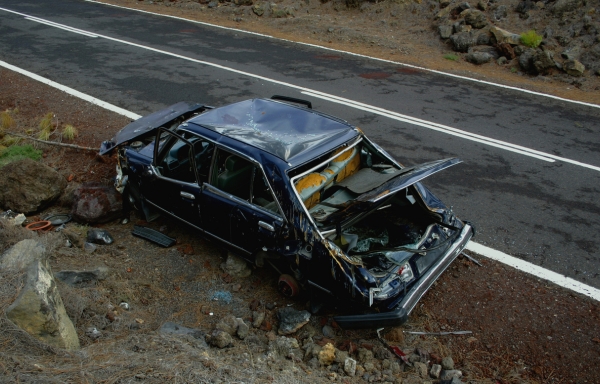
Mechanical Investigation of Identical Scooter Crashes
How can one determine if a crash is due to a rider losing control or a scooter failure?
Two incidents involving the same make and model scooter were investigated by DJS’ Principal Mechanical Engineer. Each rider reported riding on their scooter for several minutes when its handles collapsed, resulting in the crash. While the rider or witness accounts of the incident can be helpful, they are often unsure what happened. In some cases, a search of the area could reveal surveillance cameras that captured the incident and can provide additional details when footage of the incident is available. Some electric scooters pair with an application on the user’s phone and may store information that can assist in an investigation.
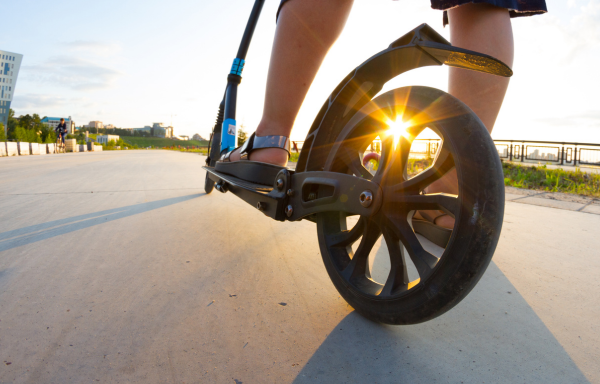
In the two cases, physical inspection of the scooters supported the riders’ accounts that the crashes were caused by scooter failures rather than operational errors. The model of scooter involved in both incidents was designed such that the solid handle stem is attached to the fork for the front wheel. Many scooters incorporate a hinge in the stem so only the stem and handle fold; however, this model has a hinge incorporated into the deck, so the stem and front wheel fold. With this design, if the assembly were to fold while in motion, the front wheel would retract, dropping the front of the deck and allowing the underside to contact the ground.
Further inspection of the scooter’s design revealed it relied on a spring-loaded pin to snap into place when the scooter was unfolded to the riding position. It was possible for the pin to travel only partially into the locking slot and sit in a position where the scooter was capable of supporting a rider, but the pin could be dislodged when force increased, such as when the scooter traveled over small discontinuities on the road or sidewalk. It was also noted that there was nothing to clearly indicate when the pin was fully engaged, nor was there any mechanism to make sure the pin could not dislodge when riding. Once the pin had disengaged, the rider’s weight on the deck would cause the front wheel to move upward and the stem to fold backward.
In both cases, scrape patterns were observed on the front underside of the scooters’ decks, which could not have occurred with the front wheel and stem locked in position. These physical findings confirmed the riders’ reports that the scooters’ handles and stems had folded while moving.
There were many questions about the scooter company’s design, development and testing. While its marketing materials and literature indicated they had designed the scooter, nearly identical scooters were found from other suppliers, all of which were manufactured overseas. There were also numerous questions about prior consumer reports of problems with the scooter staying latched, when the company first became aware of the issue, and what it did to investigate the reports. It was also noted that the company no longer offered the subject scooter design and had switched to a different design for the folding feature, in which the front wheel no longer retracted when folded and a double-action latch to release the handle was incorporated. In both cases, DJS’ mechanical engineer assisted Plaintiffs’ counsel with substantial discovery requests for information on design, development, testing and prior complaints. Once the discovery requests were served, each case settled for undisclosed amounts.
John R. Yannaccone, P.E.
Principal Mechanical Engineer
View all articles by John R. Yannaccone, P.E.