Windshield Mystery Unraveled at Vehicle Inspection
Late one evening, as Plaintiff was crossing a bridge on his drive home, another vehicle entered his travel lane and impacted the front of his vehicle. The police report indicated the encroaching vehicle had impacted the bridge and rotated as it crossed the centerline prior to striking Plaintiff’s vehicle. The police report also indicated that Plaintiff was unbelted and sustained serious head injuries when his head passed through the windshield. Defendant alleged Plaintiff’s failure to wear his seatbelt substantially contributed to his serious injuries.
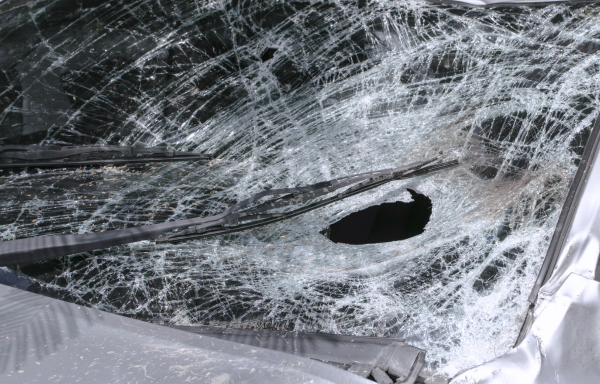
Scene photographs showed a hole through the windshield approximately ten by ten inches directly in front of the driver. They also showed a bloody piece of windshield glass, of approximately the same size, lying on the passenger front seat of Plaintiff’s vehicle. Medical records indicated he had severe facial fractures and small pieces of glass embedded in his face. This injury pattern was unusual, as head contact with a windshield does not typically cause deep fractures. Windshields are designed to deform when impacted and, generally, do not result in forces on the occupant sufficient to cause the severe fractures sustained. The geometry of the car would also make it difficult for a driver to get past the steering wheel and contact the windshield, let alone pass through it, as low as the hole was located. The deployment of the driver’s airbag would only further reduce the potential for head contact with the bottom of the windshield.
Inspection of the vehicle resulted in several unusual findings. The upper rim of the steering wheel was deformed towards the driver, rather than towards the dashboard, as typically occurs when it is contacted by an occupant. There was damage to the headliner over the driver’s position with an outward dent in the roof, and there were unusual scrapes across the hood of the vehicle and the instrument panel directly in front of the driver. A car part was also found on the rear seat; an air conditioner compressor which had been broken off. Finding such a part in a damaged vehicle is not unusual as debris is frequently placed inside vehicles by responders during cleanup of the scene.
Research into the part showed it did not belong to Plaintiff’s vehicle, but to Defendant’s vehicle, which had crossed into his lane. Scene photographs of the striking vehicle showed its air conditioning lines were hanging out of the grill area. When the compressor was compared to the hood scrapes and the hole in the windshield, it became clear Defendant’s compressor had caused this damage to Plaintiff’s vehicle.
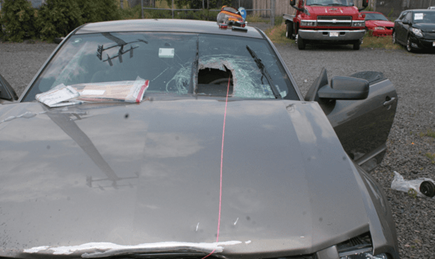
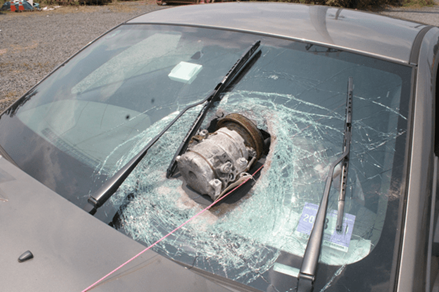
Based on the available evidence, it was determined that impact with the bridge separated the air conditioner compressor from the engine of Defendant’s car. When the two vehicles collided, the compressor scraped the hood of Plaintiff’s car, passed through the windshield, scraped the top of the dash, and impacted the top rim of the steering wheel, before impacting his face. After striking Plaintiff, the compressor was deflected upward where it contacted the headliner, causing the dent in the roof, and then fell into the rear seat where it was found.
Physical evidence found at the inspection was insufficient to determine if Plaintiff was wearing the seatbelt at the time of the crash. It was further determined that use of the seatbelt would not have changed the injuries caused by the compressor striking him in the face. Findings from the inspection also led Plaintiff’s attorney to investigate issues related to the way the component was mounted, and additional parties were subsequently added to the case.
Result: Prior to trial, a settlement was reached with all defendants.
John R. Yannaccone, P.E.
Principal Mechanical Engineer
View all articles by John R. Yannaccone, P.E.